
















ZODIAK ONLINE
ArtBridge House, Area 47
Sect. 5, P/Bag 312
Lilongwe, Malawi
Sect. 5, P/Bag 312
Lilongwe, Malawi

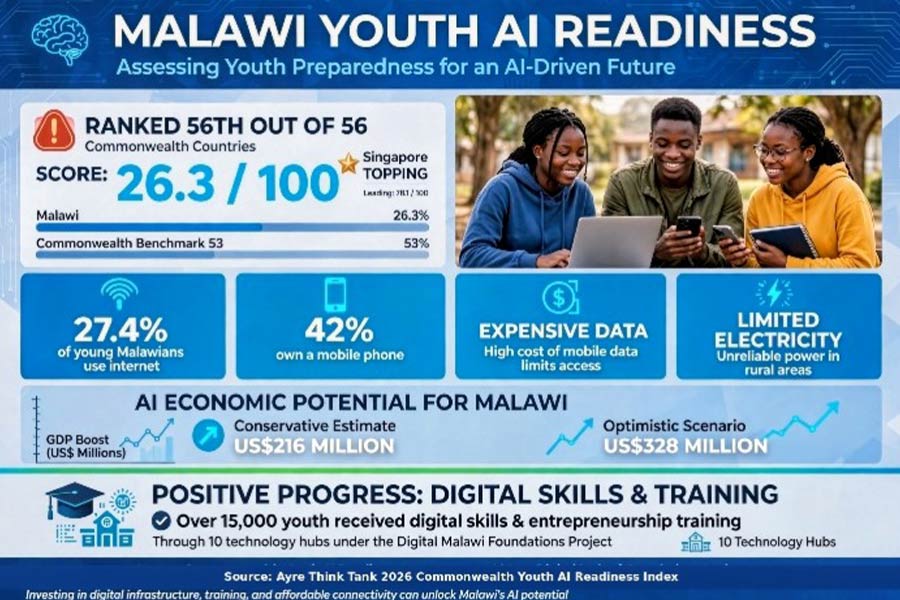
Malawi has ranked last in a new study of 56 Commonwealth countries for youth AI readiness, with limited electricity and internet access identified as major obstacles to creating new job opportunities for young people and to capturing a potential US$216 million economic boost from artificial intelligence.
The Ayre Think Tank's 2026 Commonwealth Youth AI Readiness Index, launched today at the Commonwealth Heads of Government Meeting in Antigua and Barbuda, scored Malawi 26.3 out of 100 against the study's benchmark of 53. Only 15 Commonwealth countries meet the benchmark, with Singapore topping the list.
The research finds access to technology is a major obstacle in Malawi, where 27.4 percent of young Malawians reported using the internet and 42 percent owned a mobile phone, while mobile data was also expensive in relation to incomes, making regular use of online tools difficult for many households.
Malawi scores 0 out of 10 for digital, data, media and AI capability under the Index's selected household-survey measures, which recorded very low rates of activities such as installing software, using spreadsheets and writing computer programs.
However, the report says this does not mean young Malawians have no digital or AI skills but highlights the need for stronger practical training and more comprehensive evidence of their capabilities. Education and training provision also scores poorly.
For Malawi's approximately 8.5 million young people aged 15 to 29, the potential economic stakes are substantial. Applying ten-year scenarios developed by the International Monetary Fund to Malawi's economy, researchers calculate that AI could increase the level of GDP by US$216 million under the moderate estimate, rising to US$328 million in the optimistic case.
In a statement, its founder, Calvin Ayre says AI will change work, business and wealth creation, but the race is not only for the biggest or richest countries, stressing the need for countries to give youth skills and a chance to get ahead.
"AI is going to change how we work, how we do business and how wealth is created. But this is not a race that only the biggest or richest countries can win. What matters is giving young people the skills and the chance to get ahead — whether to start businesses, find jobs or build something for themselves. Governments now have to decide what they're going to do about it," he said.
The Index nevertheless scores Malawi just 3.3 out of 10 for employment and 2.5 for education and training, highlighting why skills programmes must be accompanied by reliable electricity, affordable internet and opportunities to find jobs or establish successful businesses.
The White Paper identifies five priorities: affordable and reliable access to technology; education that develops practical skills; stronger routes from training into employment and enterprise; AI tools suited to local languages and needs; and safeguards that enable young people to question automated decisions.
It calls on governments, educators and development partners to better understand the particular barriers young people face in each country before deciding where investment can make the greatest impact.
Commenting on the report, Professor Justin Robinson, Pro Vice-Chancellor and Campus Principal of the University of the West Indies, Five Islands Campus, said: "We need to make sure that the next generation will be able to do more than just consume AI products made elsewhere. Access must come with its own agency, and a real equitable stake in how these systems are governed.
He added, "Young people need to be equipped to question these new tools, to improve them and to be supported in building alternatives suited to their own needs. Whether that happens, will depend on choices made now. The Index gives us a clearer view of where those choices are most urgent. We should use it."
However, there was no immediate response from government on the report.
But, the study noted that Malawi was already investing in the practical skills needed to turn technology into employment opportunities as World Bank review reported that more than 15,000 young Malawians, had received digital skills and entrepreneurship training under the Digital Malawi Foundations Project.