















ZODIAK ONLINE
ArtBridge House, Area 47
Sect. 5, P/Bag 312
Lilongwe, Malawi
Sect. 5, P/Bag 312
Lilongwe, Malawi

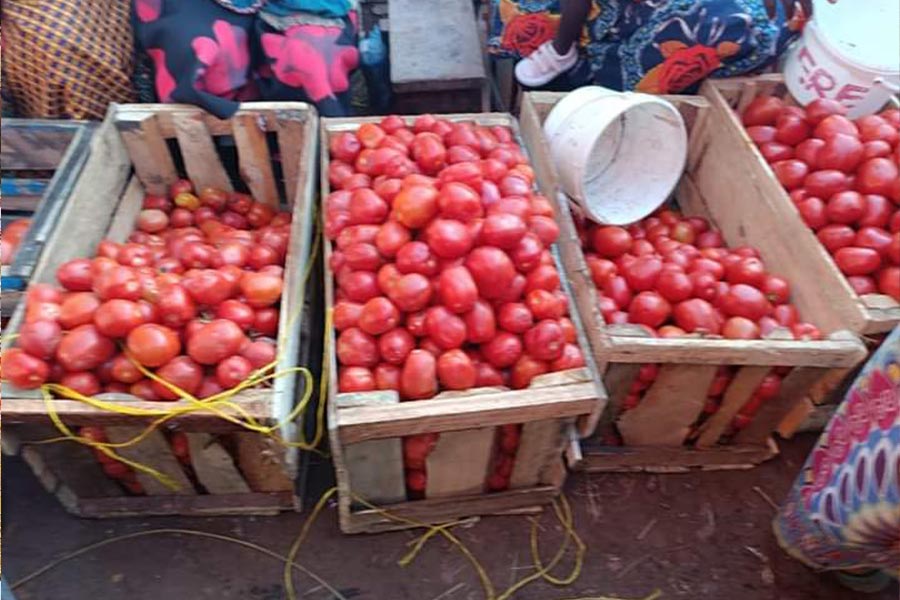
December 2025 finds Wakawaka Market in Lilongwe City alive with the hum of trade along the M1 road.
Behind a 10-ton van piled high with tomatoes, three men stand drenched in sweat, their bodies straining as they unload crate after crate.
Inside the van, three more workers keep the rhythm going, passing the heavy loads down in a steady chain. The air is thick with the scent of ripe tomatoes and the effort of human labor.
These vans, arriving from Tanzania and Zambia, have become a familiar sight. Each one carries far more produce than the smaller two-ton and three-ton trucks that once came regularly from districts like Ntcheu, Dowa, Dedza and Mzimba.
Those local trucks now appear less often, their role diminished as cross-border trade reshapes the market’s supply lines.
For the men at Wakawaka, the arrival of these larger vans is more than just a logistical shift. It represents opportunity. More tomatoes mean more unloading, more piecework, and more income.
Nyalayi Simango is one of the traders at Wakawaka Market, and among the Malawian traders who used to travel to Tanzania to order tomatoes.
She explains that she and most Malawian tomato traders no longer make the trip this season, since they mainly go their during months when tomatoes are scarce in Malawi, particularly around May and June.
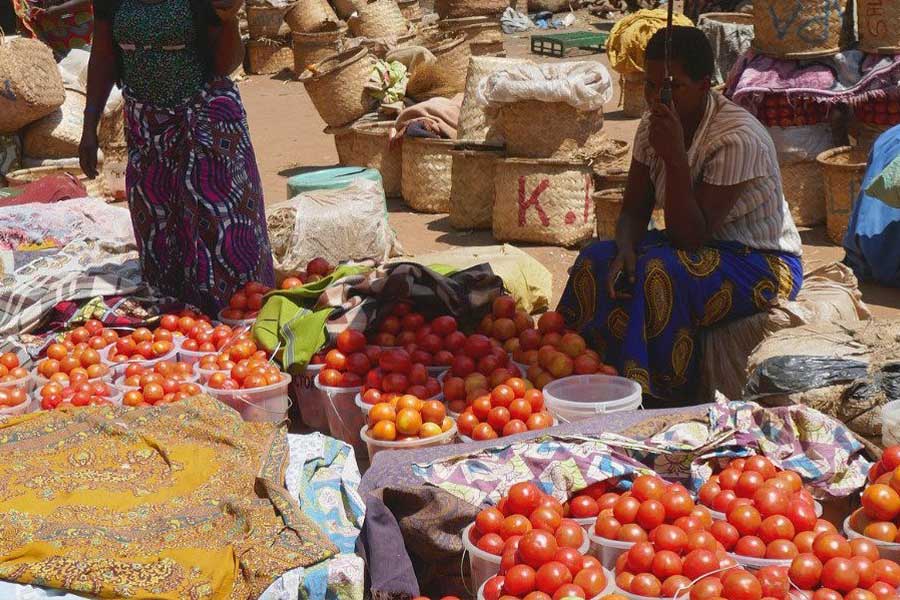
At present, most of the tomatoes being brought into the country are not handled by Malawian traders.
Simango said: “We usually travel to Zambia and Tanzania during the period when tomatoes are scarce in Malawi.
“Even if we find them expensive there, or have to exchange money at a higher rate, we still manage to make profits because tomatoes are difficult to source locally at that time.”
She added: “For example, we can go with 10 million kwacha and perhaps lose five million through unfavorable exchange rates. Yet, by the end of sales, we recover our capital and still make profits.”
According to Data from the National Statistical Office, the total exports for December 2025 amounted to US$60.9 million, showing a 5.7 percent decrease from US$64.6 million in December 2024.
On the other hand, Total imports increased from US$327.1 million in December 2024 to US$332.1 million in December 2025.
Since time immemorial, Malawi has largely been an importing nation, with limited activity in exports. This raises a critical question: are Malawian products not competitive enough?
To explore this, we sought insights from the Economics Association of Malawi. Its president, Dr. Bertha Bangara Chikadza, explains that numerous challenges contribute to the country’s weak export performance.
“Farmers and manufacturers tend to face challenges such as limited access to finance, weak storage facilities, and high transport and energy costs.”
“When supply becomes unstable or prices rise, traders naturally turn to cheaper, more reliable imports from neighboring countries. This is why products like tomatoes, which Malawi can grow, still have to be imported,” Dr. Chikadza said.
In Chiluzi Village under Traditional Authority Kasumbu in Dedza District, tomato farmer Titus Maganizo is already grappling with the impact of imported tomatoes.
Once a steady stream of traders frequented his fields, but now their visits have dwindled, leaving him concerned about shrinking demand and falling prices.
“This issue has affected us a lot. Firstly, when we grow our products, it is difficult to find reliable markets. And when traders do buy them, the prices are very low because there is an oversupply of tomatoes coming from other countries.” He expressed concern.
The fears expressed by Maganizo in Dedza District, along with other tomato farmers across the country, are not unfounded.
Agriculture expert Dr. Tamani Nkhono Mvula warns that the influx of tomatoes from a neighboring country will have a significant impact on local farmers.
However, he also notes that this challenge presents an opportunity to strategize and strengthen the industry.
“But I think it is also time that local farmers ensure they plan very well in terms of how they are going to dispose of these products. Most of the time, farmers produce without knowing how they are going to sell.”
“But it is also an opportunity for them to look for alternatives in terms of adding value to these products,” Dr. Mvula said.
Towards the end of former president Lazarus Chakwera’s tenure, his government issued a ban against importation of locally produced goods in a desperate measure to prevent forex challenges.
But was banning importation what Malawi needed at that time?

The Economic Association President Dr. Chikadza said: “The policy by former president Lazarus Chakwera had good intentions of protecting local producers and saving foreign exchange. But it was difficult to implement without first addressing production challenges.”
“When local supply cannot meet demand in terms of quality, quantity, and price, bans tend to create shortages, with rising prices and smuggling as the result. Such a policy can only work when domestic industries are already strong and competitive, which was not the case at the time the ban was implemented.”

Another economist, Edward Leman, a lecturer at the University of Malawi, agrees with Dr. Chikadza that the policy to ban importation will only succeed if Malawi produces enough quality goods to satisfy local demand.
Only then would interest in imports naturally decline. However, he cautions that such a policy must be implemented carefully.
“As long as the economy has substitutes for the goods we are banning from export, it can be a good policy, because it means consumers will be consuming from local production — provided that demand for the banned product can be met locally.”
“On the other hand, when you ban importation, there is likely to be a response from economies around the globe,” Leman said.
The University of Malawi–based economist has raised an important point: banning imports would immediately attract external pressure. This was evident when the Chakwera government introduced its importation ban—Tanzania retaliated almost instantly.
As highlighted in this analysis, Malawi should not expect a quick fix to its foreign exchange challenges.
But at least, there is a way to fix it. Both Dr. Bertha Bangara Chikadza and Edward Leman emphasize that the country must first tackle production constraints.
Malawi needs to produce more export-quality goods, meet domestic demand, and only then expand into international markets.