














ZODIAK ONLINE
ArtBridge House, Area 47
Sect. 5, P/Bag 312
Lilongwe, Malawi
Sect. 5, P/Bag 312
Lilongwe, Malawi

Twenty-four thousand farmers from 12 districts are benefiting from the Soil Health Pilot Study under the Malawi Food Systems Resilience Project, also known as AGCOM 2. The initiative—implemented in partnership with the Ministry of Agriculture and Total Land Care—supports 1,000 farmers per EPA in three selected EPAs in each participating district, providing inputs aimed at restoring soil health and boosting crop yields.
The beneficiaries fall into four groups, each receiving different input packages. One group is receiving two bags of inorganic fertilizer and 5 kg of legume seed to improve soil fertility. Another is receiving inorganic fertilizer, two bags of lime, and 5 kg of legume seed. A third group is receiving two bags of Mbeya manure plus 5 kg of legumes, while the final group is receiving 10 kg of urea and 10 kg of NPK to produce their own organic manure.
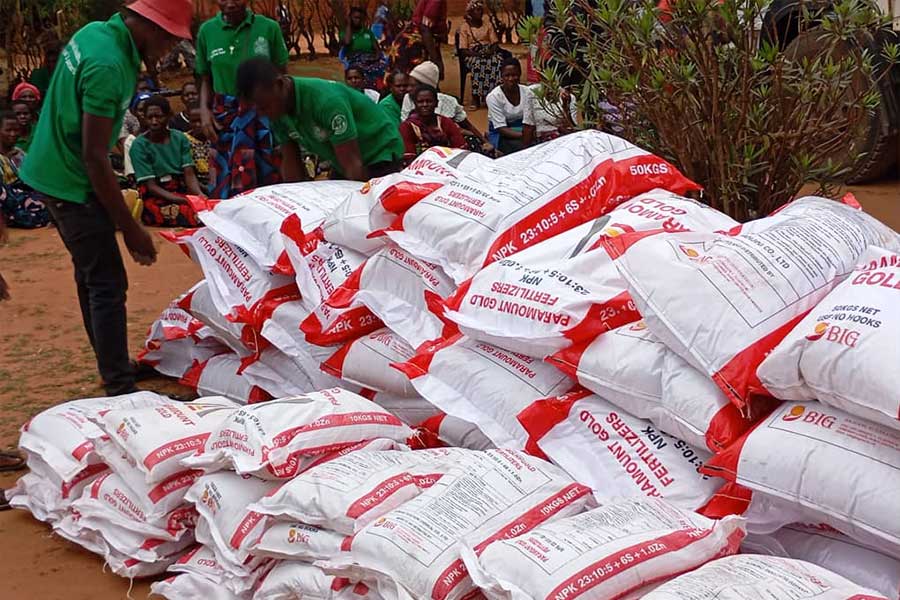
Speaking during the presentation of NPK fertilizer at Ukwe and Chigonthi EPAs in Lilongwe, AGCOM Monitoring and Evaluation expert Nichorus Mkandawire explained that the World Bank–supported study began last growing season and will run for about three seasons. He said the findings will help identify combinations of inputs that are both cost-effective for farmers and affordable for government adoption under the FISP program, allowing more households to be reached at a reasonable cost.
“Inorganic fertilizers are becoming a burden for the government as they are very expensive, leading to an increase in outstanding bills owed to suppliers. This study aims to influence AIP policy for the government,” Mkandawire said.
Beyond providing inputs, farmers are also being trained in soil and water conservation to complement other soil restoration efforts.
Total Land Care extension expert James Mlamba described the project as timely, noting that poor farming practices and erosion have left much of Malawi’s soil degraded and acidic. “Since the introduction of the affordable inputs program, we continue to experience food insecurity—despite applying inorganic fertilizers every year—because the soils have become acidic,” he said.
Through the project, Total Land Care is training farmers on proper fertilizer application and sustainable land management techniques.
Farmer Gabriel Sikalemela from Chinyama Village in TA Kabudula shared that he harvested 85 bags of maize from one hectare during the first season. “The Soil Health Pilot Project has helped my family achieve food security. Even the soil color and texture on my farm have changed, showing that lost nutrients are being restored. We expect a higher yield this season,” he said.
Another farmer, Janet Mager from Godi Village in the same area, is in the group receiving 10 kg of urea and 10 kg of NPK for making Mbeya manure. She harvested 25 bags of maize in the first season, selling 10 to buy a goat and chickens. She plans to build a better house for her family after this next harvest.
The Soil Health Pilot Study aims to promote affordable, sustainable soil fertility solutions for both farmers and the government’s AIP program. It is currently being implemented in Lilongwe, Blantyre, Mangochi, Machinga, Mulanje, Chitipa, Rumphi, Karonga, Mzimba, Mchinji, Ntcheu, and Kasungu.